
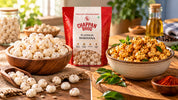
What Is the Difference Between Raw Makhana and Roasted Makhana?
, by Akash Jain, 23 min reading time
, by Akash Jain, 23 min reading time
Understanding raw makhana vs. roasted makhana is useful because the two forms differ in texture, taste, preparation, and convenience.
Makhana is a popular Indian snack that has earned a place in many households because of its light texture, mild flavour and versatility. Also known as fox nuts or lotus seeds in everyday conversation, makhana can be enjoyed in different forms, from traditional preparations to quick snacks seasoned with everyday spices.
However, one question often comes up when choosing makhana: should you eat it raw or roasted?
Understanding raw makhana vs roasted makhana is useful because the two forms differ in texture, taste, preparation, and convenience. Raw makhana, as commonly sold in Indian markets, is generally dried and unroasted rather than fresh or completely untreated. Roasted makhana has been heated to develop a crispier texture and a more pronounced flavour.
The right choice depends on how you plan to eat it. You might prefer roasted makhana for an evening snack, while unroasted makhana may be more suitable when you want to prepare a curry, kheer, or another cooked dish.
In this guide, we will explain the difference between raw and roasted makhana, explore their nutritional characteristics, discuss their practical benefits, and share simple tips for preparing makhana at home. We will also address common misconceptions so you can make an informed choice for your everyday diet.
Makhana is the edible seed of Euryale ferox, an aquatic plant grown in parts of India and other Asian regions. Bihar, particularly the Mithila region, is widely known for makhana cultivation and processing.
The seeds are harvested, dried, and processed using specialised techniques that help them expand into the familiar white, airy, puffed form commonly sold as fox nuts.
Makhana is used in several Indian dishes, including:
Although people frequently call makhana lotus seeds, Euryale ferox is botanically distinct from the lotus plant. This distinction is useful when comparing food labels and nutritional information.
The important point is that makhana is available in different preparation states. A bag of dried, unroasted makhana is not the same as fresh seeds, and commercially roasted makhana may contain added oil, salt, sugar or flavouring ingredients.
The main difference between raw and roasted makhana lies in how the product is prepared and how it tastes and feels when eaten. Both can fit into a balanced diet, but the better option depends on your recipe, flavour preferences, and nutritional goals.
|
Feature |
Unroasted makhana |
Roasted makhana |
|
Texture |
Usually firm or less crisp |
Light, crisp, and crunchy |
|
Taste |
Mild and relatively neutral |
Toasty, often slightly nutty |
|
Preparation |
Suitable for further cooking or roasting |
Ready to eat if properly processed and packaged |
|
Cooking uses |
Curries, kheer, and other recipes |
Snacks, trail mixes, and toppings |
|
Added ingredients |
Often none, depending on the product |
May contain oil, salt, sugar or spices |
|
Storage |
Must be kept dry and protected from moisture |
Must also be stored airtight to maintain crispness |
|
Convenience |
May need preparation |
Usually more convenient for immediate snacking |
These are general characteristics. Product quality, processing methods, and storage conditions can affect the final result.
Texture is one of the easiest ways to distinguish the two forms.
Unroasted, puffed makhana may feel slightly firm or less crisp, particularly if it has absorbed moisture during storage. Properly roasted makhana is generally lighter and crunchier because heating reduces its moisture content.
For example, if you open a packet of makhana and find that the pieces feel chewy rather than crisp, a short roasting session in a dry pan may help restore their texture, provided they have not become spoiled or contaminated.
Unroasted makhana has a mild flavour that works well in recipes where other ingredients provide most of the taste.
Roasting develops a toasted aroma and a more pronounced flavour. Adding a small amount of ghee, black pepper, cumin, or turmeric can make the snack more appealing without requiring a heavy coating of seasoning.
This is one reason roasted makhana is popular for evening snacking. It can be prepared in minutes and adjusted to suit different preferences.
If convenience is your priority, roasted makhana is usually the easier choice. You can eat it directly from a suitable ready-to-eat package or prepare it quickly at home.
Unroasted makhana offers more flexibility when cooking. You can roast it before adding it to a dish or use it as an ingredient in a recipe that calls for additional cooking.
The key is to understand the package instructions. If a product is intended for cooking or further processing, do not automatically assume it is ready to eat.
Plain unroasted and plain roasted makhana can both be low in fat compared with many fried snack foods. However, the nutritional difference depends on the actual product and serving size.
Roasting can reduce moisture, which means nutrients may appear more concentrated per 100 grams. Adding oil or ghee also increases the energy content of the finished snack. Sugar coatings and salty seasonings can change its nutritional profile further.
Therefore, compare product labels rather than assuming every roasted product is healthier or more calorific than every unroasted one.
Understanding makhana's nutritional value helps you choose a preparation method that suits your everyday eating habits.
Makhana is primarily a carbohydrate-rich food, with some protein and generally very little fat in its plain form. It also contains minerals and other naturally occurring compounds. Exact nutrient levels vary with the variety, growing conditions, processing method, and moisture content.
A published study comparing roasted and unroasted fox nuts found changes in measured protein, mineral content, and antioxidant-related compounds after roasting. The researchers also observed a lower glycaemic index for the roasted sample tested. These findings are interesting, but they should not be treated as a guarantee that all roasted makhana products have the same nutritional properties.
For wider dietary context, the Indian Council of Medical Research and its National Institute of Nutrition provide official dietary guidance that emphasises variety and balance rather than relying on a single food to meet nutritional needs.
Not necessarily. The effect depends on the nutrient, the temperature, the duration of heating, and the food's moisture content.
Roasting may reduce moisture and increase the measured concentration of certain components per 100 grams. It may also change the availability or measurable levels of some plant compounds. At the same time, heat-sensitive compounds can be affected by excessive heating.
It is therefore too simplistic to say that raw makhana always contains more nutrients or that roasting automatically makes it nutritionally superior.
The practical lesson is to choose good-quality makhana, avoid burning it, and pay attention to what is added during preparation.
The potential raw makhana benefits are primarily related to its versatility, simple ingredient profile, and suitability for further cooking. Here, “raw” means dried, unroasted makhana as commonly sold in shops, not necessarily fresh seeds straight from the plant.
Unroasted makhana can be used in both savoury and sweet recipes. You can roast it yourself, simmer it in a suitable dish, or prepare it according to a recipe's instructions.
For example, if you are making makhana kheer for a family gathering, you may prefer to select unseasoned makhana so that the sweetness, milk, and spices determine the final flavour.
Starting with plain makhana lets you decide whether to add oil, ghee, salt, sugar, or spices.
This can be helpful if you are monitoring your salt intake or prefer to keep packaged seasonings to a minimum. However, ingredient control does not automatically make the final recipe low in calories; the quantity of added fat and sugar still matters.
Makhana is commonly used in Indian home cooking. Depending on the recipe, it may be roasted before being added to a gravy or cooked with milk for a dessert.
Its mild flavour allows it to absorb seasonings and work alongside ingredients such as cumin, cardamom, nuts and milk.
Plain, properly packaged makhana can be convenient to keep at home for recipes and snacks.
Check the packaging for storage instructions and use clean, dry utensils. If the product smells unusual, shows signs of mould, or has been exposed to moisture for a prolonged period, discard it rather than attempting to rescue it by roasting.
Best suited for: People who enjoy cooking, want control over seasonings, or regularly prepare homemade makhana dishes.
The main roasted makhana benefits relate to convenience, flavour and the ability to prepare a satisfying snack with relatively simple ingredients.
Plain roasted makhana can provide a crunchy alternative to crisps or heavily fried snack foods. Its overall nutritional value still depends on the portion, ingredients, and the rest of your diet.
For instance, a small bowl of makhana roasted with a little ghee and pepper may be a practical alternative to reaching for a large packet of salty snacks every evening.
Roasted makhana works with a variety of seasonings:
You can prepare a batch with minimal seasoning and add stronger flavours to individual portions.
Roasted makhana can be portioned into small containers for work, travel, or study breaks. It requires little preparation when it has already been roasted and stored correctly.
For best results, allow homemade makhana to cool completely before sealing it in an airtight container. Trapping steam inside the container can soften the snack.
Plain roasted makhana can contribute energy, some protein, and minerals. However, it is not a complete meal and should not replace a varied diet.
Pairing it with other nutritious foods across the day helps provide a broader range of nutrients. If you need a more substantial snack, consider serving a moderate portion alongside plain yoghurt or another food that suits your dietary needs.
Best suited for: People looking for a convenient, crunchy snack that can be prepared with controlled amounts of oil, salt, and seasoning.
Learning how to roast makhana at home is straightforward. You do not need specialised equipment, and a heavy-bottomed pan is usually sufficient.
The goal is to remove excess moisture and develop a crisp texture without burning the delicate puffed pieces.
Step 1: Check the makhana
Remove damaged pieces and check that the makhana is clean, dry and free from unusual odours or visible mould. Do not wash it immediately before dry roasting, as surface moisture can interfere with crisping.
Step 2: Heat a pan over low to medium-low heat
Add the makhana to a dry, heavy-bottomed pan. Keep the heat moderate and stir regularly to help the pieces heat evenly.
Step 3: Roast until crisp
Continue stirring for approximately 5–10 minutes, adjusting the time to suit the batch size and pan. Check a piece after cooling it briefly. Properly roasted makhana should feel crisp rather than chewy.
Step 4: Add seasoning
If using ghee or oil, add a small amount and toss to coat evenly. Add spices near the end, then stir briefly so they do not burn.
Step 5: Cool before storing
Spread the roasted makhana on a plate and let it cool completely. Store it in a clean, airtight container away from humidity.
Practical tip: Do not judge crispness while the makhana is still very hot. Allow a piece to cool for a short time before testing it. If the centre remains chewy, continue roasting gently.
The best way to eat makhana depends on whether you want a quick snack, a cooking ingredient, or something more substantial between meals.
This is a simple option when you want to control your intake of added salt, sugar, and fat. Roast the makhana thoroughly and season it lightly, or leave it plain.
Combine a measured portion of roasted makhana with a small amount of almonds, pumpkin seeds, or other preferred nuts and seeds. This creates a more varied snack, although nuts and seeds also contribute calories.
Lightly roast the makhana before adding it to a curry when the recipe calls for it. Add it at the appropriate stage so it absorbs some flavour without becoming excessively soft.
Makhana can be simmered in milk with cardamom and a sweetener to prepare a traditional dessert. If you want to moderate added sugar, start with a smaller amount and adjust to taste.
Prepare individual portions in advance instead of eating directly from a large container. This makes it easier to keep track of how much you consume, especially when snacking while working.
There is no universally ideal serving size for everyone. Your energy needs, activity level, overall diet, and any relevant medical advice should guide portion choices.
Choosing between raw and roasted makhana becomes easier when you understand what these terms do—and do not—mean.
Most makhana sold as a snack is already dried and processed into its familiar puffed form. “Raw” in a retailer's description often means unroasted, not fresh from the plant.
Always check the product description and preparation instructions.
Research has found that roasting can change the measured composition of fox nuts. However, the results depend on the processing conditions and the basis used for comparison, including whether moisture loss is accounted for.
It is inaccurate to conclude that every roasted product is nutritionally superior to its unroasted equivalent.
A small amount of fat can improve flavour, but adding large quantities increases the energy content of the snack. If you prefer a lighter preparation, try dry roasting first and add seasoning gradually.
Flavoured makhana can contain significant added salt or sugar, depending on the recipe or product. Check the nutrition label and ingredient list, particularly if you eat it frequently.
Warm makhana can release steam into a closed container. That moisture may reduce crispness and encourage deterioration over time.
Cool it fully before storage and always use a clean, dry container.
Makhana can be included in a balanced diet, but no single food guarantees weight loss. Total energy intake, food quality, activity, and other individual factors all matter.
Whether you choose unroasted or roasted makhana, the condition of the product matters.
For consumers comparing packaged options, Chappan Bhog Makhana can be considered alongside other brands by reviewing the ingredient list, packaging details, product condition, and available nutrition information. The most suitable option is the one that meets your needs and provides clear, reliable product information.
The choice between raw makhana and roasted makhana comes down to your intended use, preferred texture, and control over ingredients. Unroasted makhana is versatile for home cooking, while roasted makhana is an easy option when you want a crunchy snack without much preparation.
Understanding the difference between raw and roasted makhana also means looking beyond the preparation method. Product quality, portion size, added ingredients, and storage all influence the final eating experience.
If you enjoy preparing snacks at home, start with plain makhana and roast a small batch with minimal seasoning. If convenience matters more, compare ready-to-eat options, including Chappan Bhog Makhana, by checking their ingredients and product information.
Ultimately, both forms can have a place in a varied diet. Choose the one that suits your routine, prepare it appropriately, and enjoy it as part of a balanced approach to eating.
Neither form is automatically healthier. Plain, unroasted makhana offers flexibility for cooking and seasoning, while plain roasted makhana is convenient and crunchy. Roasting can change moisture levels and the measured concentration of certain nutrients. The overall comparison also depends on serving size and whether oil, salt, or sugar has been added.
Many products described as raw makhana are actually dried, puffed, and unroasted. Whether they can be eaten directly depends on the product's processing and packaging instructions. Follow the manufacturer's directions and cook or roast the product if instructed. Do not assume that fresh or inadequately processed seeds are equivalent to ready-to-eat puffed makhana.
Roasted makhana is convenient, crunchy, and easy to season. Plain versions are generally low in fat and provide carbohydrates, some protein, and minerals. Its suitability as a snack depends on the portion and added ingredients. Roasting does not make it a complete meal or guarantee a particular health outcome.
Yes, roasting can change moisture content and affect measured nutrient concentrations and certain plant compounds. A study of fox nuts reported differences in protein, minerals, phenolics, and other measured properties after roasting. However, these findings apply to the samples and methods studied, not automatically to every commercial product.
Allow it to cool completely before transferring it to a clean, airtight container. Keep the container away from steam, direct moisture, and humid areas. Use dry utensils when serving and follow the manufacturer's storage instructions. If the makhana becomes soft but remains otherwise safe, gentle reheating may restore some crispness. Do not attempt to salvage food that shows mould, unusual odours, or other signs of spoilage.